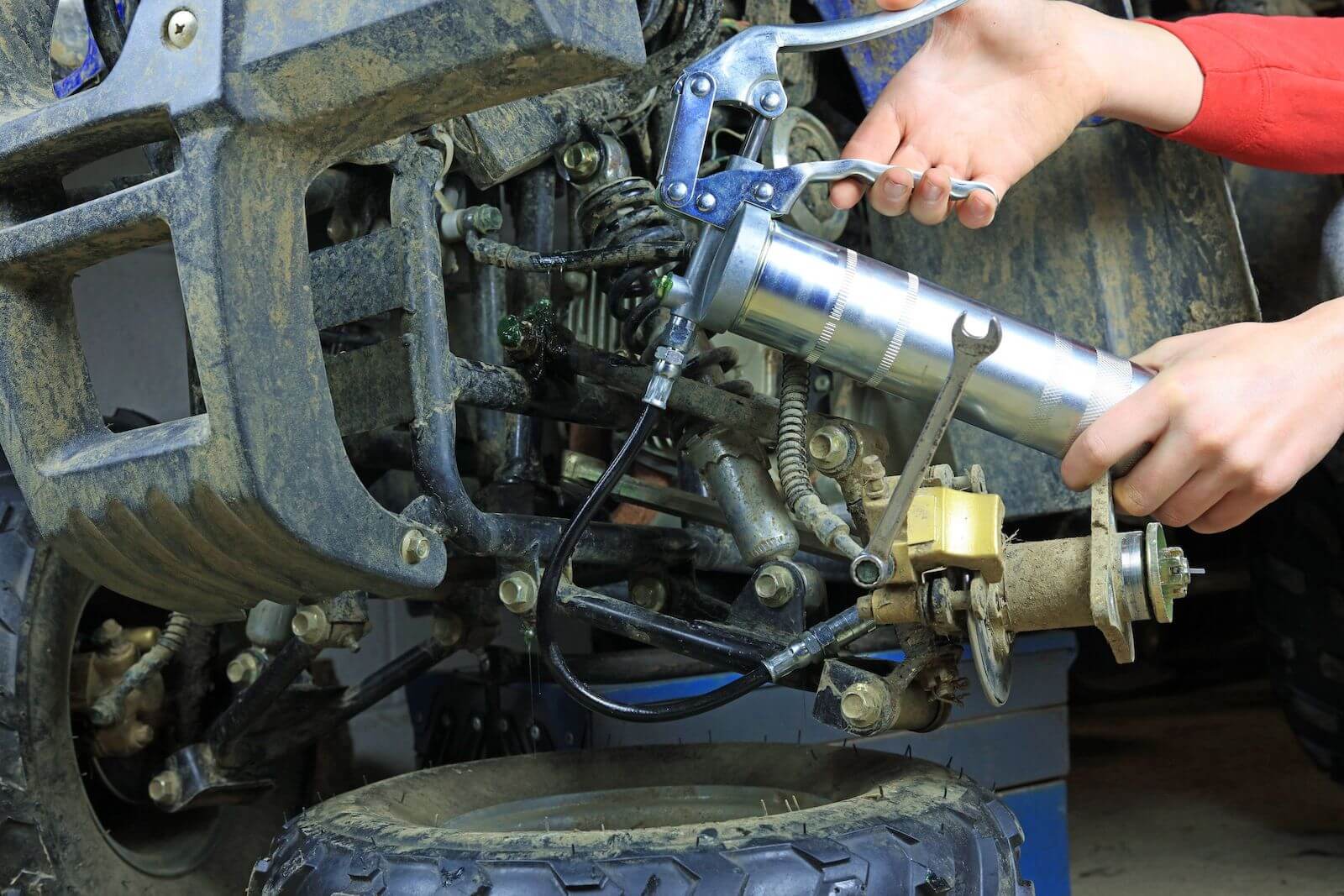
A LockNLube® grease coupler addresses the connection at the zerk fitting, while Lube-Shuttle® improves how grease is loaded, identified, and delivered from the cartridge. AET Systems has partnered with LockNLube® to bring the two together: a Lube-Shuttle® grease-gun system fitted with a locking LockNLube® tip. The result is a cleaner, simpler setup from the cartridge to the grease fitting.
The coupler is an important part of that setup, but Lube-Shuttle® remains the foundation. Its threaded cartridge design replaces the conventional process of opening a gun barrel, inserting a cartridge, removing seals, reassembling the gun, and dealing with air pockets or grease around the follower. Adding a LockNLube® tip strengthens the delivery end of the system by creating a secure connection at the zerk.
What you need to know
- Lube-Shuttle® uses a threaded grease cartridge that connects directly to a compatible grease gun.
- The grease label and remaining quantity stay visible while you work.
- The system is designed for cleaner cartridge changes with less handling of exposed grease.
- The LockNLube® coupler uses locking jaws and a thumb-operated sleeve to connect to a zerk fitting.
- LockNLube publishes that its original coupler is rated to 10,000 psi and works with DIN and SAE specification zerks.
- The combined product is available from AET Systems as the Lube-Shuttle® LockNLube® Coupler.
- The grease itself still must meet the equipment manufacturer's specification.
The Lube-Shuttle® system solves the cartridge side of greasing
Most conversations about grease guns start at the coupler. That misses half of the job. Before grease reaches a fitting, it has to move from its package into the gun without contamination, unnecessary waste, or time-consuming priming.
The Lube-Shuttle® system is built around a threaded cartridge. The published loading sequence is straightforward:
- Remove the cartridge cap.
- Push up on the cartridge plunger.
- Thread the cartridge into the compatible Lube-Shuttle® grease gun.
- Start greasing.
There is no conventional gun barrel to open for a routine cartridge change. The cartridge remains outside the gun, so the product label and remaining grease quantity can be seen during the job.
Cleaner cartridge changes
Conventional grease-gun loading can expose the operator, gun components, and work area to grease. A threaded Lube-Shuttle® cartridge reduces those handling steps. The cartridge screws into the tool as a contained package, helping keep grease where it belongs.
Cleaner loading is not only about appearance. Dirt introduced during cartridge handling can travel through the gun and hose toward a lubricated component. A contained cartridge system does not replace good housekeeping, but it removes several opportunities to handle exposed grease.
Easier grease identification
The visible cartridge helps a technician confirm which grease is installed before approaching a fitting. That matters when a shop carries multiple products for bearings, pins and bushings, electric motors, food-processing equipment, marine service, or specialty applications.
Never identify grease by color alone. Confirm the product name and check the equipment manual for the required NLGI grade, thickener, base oil, performance requirements, quantity, and service procedure. Do not mix greases without published compatibility support.
A system that works across more than one tool
The current Lube-Shuttle® site describes the threaded cartridge as a lubricant-delivery platform for manual, pneumatic, and electric grease guns, along with other compatible application tools. That lets the cartridge system—not a single gun—organize how grease is stored and used.
The LockNLube® coupler improves the fitting connection
Once the cartridge and gun are ready, the coupler must connect to the zerk fitting. A worn or poorly fitting conventional coupler may leak around the zerk, pop off, or require the operator to hold it in position.
LockNLube's published design uses four hardened-steel jaws, a sliding sleeve, and a thumb lever. The jaws lock onto the zerk to create a rigid connection. Pressing the thumb lever releases the coupler, including when pressure remains at the fitting.
For the original LockNLube® Grease Coupler, the manufacturer publishes:
- Maximum pressure: 10,000 psi (690 bar)
- Zerk compatibility: DIN and SAE specification zerks
- Coupler thread: 1/8-inch NPT female
- Grease-gun compatibility: manual, pneumatic, and electric types
- Locking mechanism: four hardened-steel jaws
- Replaceable seal and jaws
Those are LockNLube's published specifications for its original coupler. Confirm the specifications and included components of the AET Systems product before purchase if your application depends on a particular connection, dimension, or configuration.
Why the two systems work well together
The value of the Lube-Shuttle® and LockNLube® combination is easiest to understand by following the grease path.
1. The cartridge threads into the gun
The Lube-Shuttle® cartridge handles the supply side. The grease remains in its labeled cartridge, and the operator avoids opening a conventional barrel during a normal reload.
2. The grease stays identifiable
Because the cartridge remains visible, the technician can verify the installed product before greasing. That is useful in mixed-equipment operations where one grease is not appropriate for every component.
3. The coupler locks onto the zerk
At the delivery end, the LockNLube® tip locks onto a compatible zerk. The operator does not have to hold a conventional coupler in alignment while operating the grease gun.
4. Grease is directed into the fitting
LockNLube describes its seal as directing grease into the bearing instead of allowing it to leak around the fitting. A secure coupler connection can reduce mess at the service point when the fitting and lubrication passage are in working condition.
5. The coupler releases with the thumb lever
After the required amount of grease is delivered, the thumb lever releases the locking jaws. Do not pull or pry a pressurized coupler from a fitting. Follow the coupler instructions and the grease-gun manufacturer's pressure-release procedure.
Together, these steps address two common sources of frustration: handling a conventional cartridge and maintaining a reliable connection at the zerk. That is why AET Systems offers the partnership product as a complete-system improvement—not merely another coupler attached to another grease gun.
AET Systems brings two recognized greasing technologies together
AET Systems partnered with LockNLube to offer operators a Lube-Shuttle® setup with the familiar LockNLube® locking tip. LockNLube has built strong recognition around its lock-on coupler. Lube-Shuttle® brings the broader cartridge and lubricant-delivery system that sits behind the coupler.
The combination gives an operator one coordinated setup:
- A threaded, externally mounted Lube-Shuttle® cartridge
- Visible grease identification and remaining quantity
- Cleaner cartridge handling
- A LockNLube® tip that locks onto compatible zerks
- Thumb-lever release at the fitting
- A rebuildable coupler design with replaceable seal and jaws
This is the practical strength of the partnership. LockNLube improves the last connection in the grease path. Lube-Shuttle® improves the full process of loading, identifying, changing, and delivering the grease.
How this setup helps reduce mess and frustration
No grease system can make a blocked fitting, incompatible grease, damaged hose, or neglected bearing disappear. A well-designed system can remove avoidable handling and connection problems.
Less grease handling at reload
The Lube-Shuttle® cartridge threads into the gun, reducing the need to open the barrel and manipulate a conventional cartridge inside the tool.
Less leakage at a properly functioning fitting
The LockNLube® coupler is designed to seal at the zerk and remain locked on under pressure. That helps direct grease through the fitting instead of around the connection.
Less guesswork about the installed grease
The cartridge label remains visible. A technician can check the product before connecting to a service point rather than relying on memory or grease color.
Fewer interruptions during a fitting route
A threaded cartridge, visible grease supply, and hands-free coupler connection can make it easier to work through a lubrication route consistently. Actual time savings will vary by equipment, fitting condition, access, grease viscosity, temperature, and operator practice; no universal savings figure is assumed.
How to use the Lube-Shuttle® LockNLube® setup correctly
- Confirm the equipment manufacturer's grease specification and service procedure.
- Check the Lube-Shuttle® cartridge label before loading the gun.
- Inspect the grease gun, hose, coupler, and pressure controls for damage.
- Wipe the zerk clean before attaching the coupler.
- Lock the coupler onto the fitting according to the coupler instructions.
- Apply only the manufacturer-specified amount of grease.
- Stop if the fitting will not accept grease, the hose is damaged, or a seal begins to move or bulge.
- Use the thumb lever and the prescribed pressure-release procedure to disconnect.
- Wipe away displaced grease and cap or store the coupler where dirt cannot enter it.
Grease guns can generate high pressure. Wear appropriate eye protection, keep hands away from suspected pinhole leaks, and never use a hand to search for a leak. Lock out moving equipment, lower or mechanically support raised components, and follow the equipment and grease-gun manufacturers' instructions.
When a locking coupler will not solve the problem
A coupler cannot correct every greasing fault. Stop and inspect the system if:
- The zerk is broken, badly worn, painted over, or the wrong type.
- Dirt has blocked the fitting.
- Hardened grease or contamination blocks the lubrication passage.
- The bearing or component is already full and the service procedure does not allow more grease.
- The hose, gun, coupler, or pressure-release device is damaged.
- Grease escapes from a seal or another unintended location.
Do not respond by applying uncontrolled pressure. Replace a defective fitting only under the equipment manufacturer's procedure, and consult a qualified technician when the blockage or component condition is uncertain.

Frequently asked questions
Does a LockNLube® coupler work with Lube-Shuttle®?
AET Systems offers a Lube-Shuttle® LockNLube® Coupler product that combines the LockNLube® locking tip with the Lube-Shuttle® system. Confirm the product configuration and compatibility with your specific gun before ordering.
Is the coupler the main advantage of the system?
The coupler improves the connection at the zerk, but Lube-Shuttle® provides the larger system advantage: threaded cartridge loading, visible grease identification, cleaner changes, and compatibility with multiple Lube-Shuttle® delivery tools.
Will the LockNLube® coupler stop every grease leak?
It is designed to create a leak-resistant locked connection at a compatible, serviceable zerk. It cannot correct a damaged fitting, blocked passage, failed seal, incompatible component, or damaged hose.
Can I use one grease for every fitting?
Only when the equipment manufacturers support that grease for every application. Select grease by the published requirement—not by convenience, color, or the coupler attached to the gun.
Is the LockNLube® coupler rebuildable?
LockNLube publishes that the original coupler has replaceable seals and jaws. Follow the manufacturer's inspection, cleaning, and rebuild instructions.
Build the complete system from the cartridge to the zerk
The LockNLube® tip is a useful final connection, but the Lube-Shuttle® cartridge system is what changes the entire greasing routine. It keeps the cartridge visible, simplifies routine loading, supports cleaner grease changes, and works across compatible application tools. AET Systems' partnership with LockNLube brings a recognized locking coupler to that broader system.
Shop the Lube-Shuttle® LockNLube® Coupler and choose the correct Lube-Shuttle® grease for your equipment's published requirements.